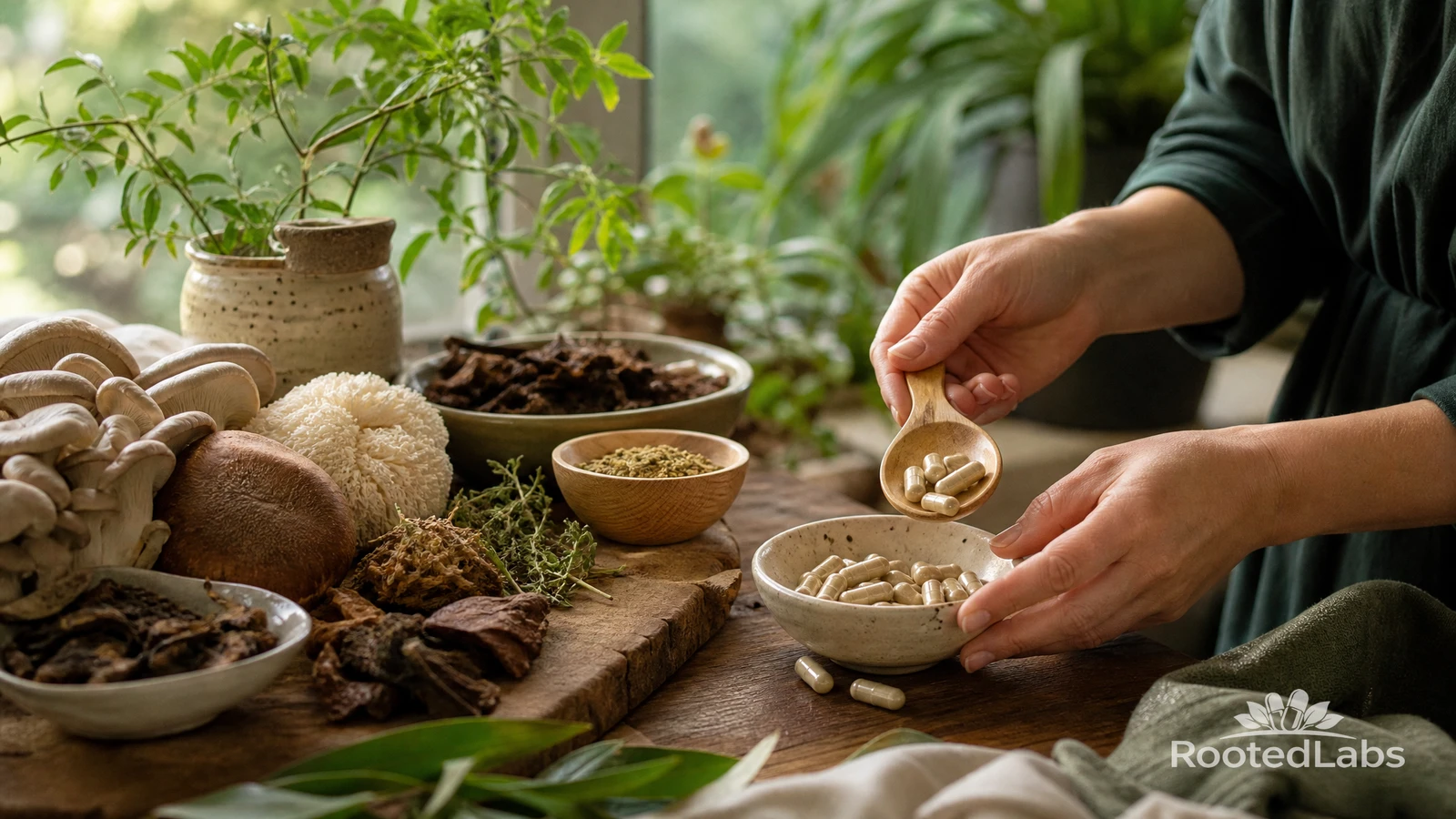
A capsule purity review should do more than count ingredients or repeat a front-label claim. For a daily supplement, purity is the full chain of decisions behind the capsule: what plant or mushroom material is used, how it is processed, what the capsule is made from, what is left out, and whether the label gives you enough detail to verify the formula.
That standard matters most when a supplement is meant to become part of a steady routine. A capsule may look clean from the outside while containing a low-potency powder, grain-based filler, undisclosed blends, or an extract without meaningful standardization. The goal is not to find a perfect product with the longest list of claims. It is to find one with a formula you can understand and use consistently.
Capsule Purity Review: Start With the Active Material
For mushroom supplements, the most useful purity question is simple: what is actually inside the capsule? The answer is not always obvious from a label that says “mushroom blend” or displays a mushroom image prominently.
Mushroom products generally use one of two source materials: fruiting bodies or mycelium. The fruiting body is the recognizable mushroom structure. Mycelium is the root-like network used to grow fungi, often cultivated on grain. Neither term automatically makes a product good or bad, but the distinction becomes significant when a mycelium ingredient is harvested with its grain-growing medium still present. That can increase starch content while reducing the amount of mushroom-derived compounds per serving.
A formula made from 100% fruiting body provides a cleaner starting point for shoppers who want to avoid grain-based mycelium fillers. Look for this stated clearly, not implied through product photography or broad language such as “full-spectrum mushroom.” If a brand does not identify the mushroom part used, there is not enough information to judge that decision.
The same principle applies to botanical ingredients. Turmeric and ginger can be valuable supporting ingredients, but a transparent label should identify them by name and amount. A proprietary blend that combines several botanicals into one total weight makes it difficult to know whether each ingredient is present at a meaningful level.
Extracts Tell You More Than Powder Alone
Raw mushroom powder and standardized mushroom extract are not interchangeable. Powder is simply dried material that has been milled. An extract goes through an additional process intended to concentrate or make more available certain naturally occurring compounds.
For Maitake, polysaccharides are one of the most relevant compounds to review. A label that identifies a standardized polysaccharide percentage gives you a concrete quality marker. For example, 500 mg of a Maitake fruiting-body extract standardized to 50% polysaccharides tells a clearer story than 500 mg of unspecified mushroom powder.
Standardization does not mean a supplement is a cure, and it does not guarantee identical outcomes for every person. Bodies, diets, medications, sleep, and overall health routines differ. What it does provide is consistency: each serving is formulated to meet a defined specification rather than relying on the natural variation of an unstandardized raw material.
When reviewing an extract, ask three practical questions. Does the label disclose the extract amount? Does it name the compound or marker being standardized? Does it state the percentage? Clear answers help separate formulation details from marketing language.
Look Closely at Fillers and Capsule Materials
“Other ingredients” are not automatically a warning sign. Capsules need a shell, and some manufacturing processes require a small amount of flow support. Still, this section deserves the same attention as the Supplement Facts panel.
A clean formula keeps this list short and understandable. Vegan HPMC capsules, also called hypromellose capsules, are a common plant-based choice. They are suitable for people avoiding gelatin and offer a straightforward alternative to animal-derived capsule shells.
The concern is not that every additional ingredient is harmful. The concern is unnecessary complexity. Artificial colors, excessive coating agents, vague “natural flavors,” or a long list of processing aids may not fit the expectations of someone choosing a simple daily mushroom supplement.
It also helps to distinguish capsule purity from allergen suitability. A vegan capsule does not automatically mean a product is free from every potential allergen. If that is important to you, review allergen statements and manufacturing disclosures rather than relying on a single front-label icon.
Black Pepper and Supporting Ingredients Need Context
Some formulas pair mushroom extracts with complementary botanicals. Turmeric and ginger have long histories of use in food and wellness traditions, while black pepper extract is often included for its piperine content. Piperine may influence how the body processes certain compounds, which is why its amount and standardization should be disclosed.
More ingredients are not always better. A supporting ingredient should have a clear purpose, a listed amount, and a role that makes sense within the formula. For example, magnesium citrate may be included as a separate mineral ingredient, while black pepper extract may support the broader botanical design. The label should make those distinctions easy to see.
There is also a trade-off to consider. Black pepper extract can interact with how some medications are metabolized. People who are pregnant or nursing, managing a health condition, or taking prescription medications should speak with a qualified healthcare professional before adding a supplement that contains piperine or concentrated botanicals. A careful purity review includes whether a formula fits your circumstances, not just whether it meets a general quality standard.
Manufacturing and Testing Are Part of Purity
Ingredient transparency is essential, but it is only one side of the equation. Quality control during manufacturing helps protect the integrity of the finished capsule. For US shoppers, products made in facilities that follow current Good Manufacturing Practices provide a more dependable baseline than products with no manufacturing information at all.
“Made in the USA” is worth treating as a useful detail, not a complete verdict. It can indicate domestic manufacturing oversight, but it does not by itself explain where every raw ingredient originated or what testing was performed. Stronger brands give specific, accessible information about their manufacturing standards and avoid suggesting that country of manufacture alone proves purity.
Testing matters because raw botanicals and mushrooms can vary by harvest and source. Depending on the ingredient, appropriate quality controls may include identity verification and screening for contaminants such as heavy metals, microbes, pesticides, or residual solvents. Not every brand will publish every test result on its label, but it should be able to communicate its quality approach without evasive language.
Be cautious with broad claims such as “lab tested” when no testing scope is described. The useful follow-up is: tested for what? Identity, potency, and contaminant testing each answer different questions.
Read the Label as a Daily Routine, Not a Sales Pitch
The best capsule is not necessarily the one with the most dramatic promise. A daily supplement should be easy to understand, easy to take, and practical to replenish. Start by checking serving size and capsule count. A 60-count bottle may provide 30 days when the serving is two capsules, while a 120-count bottle can support a 60-day routine under the same directions.
That math matters. If the bottle size, serving directions, and active amounts do not align clearly, it is harder to plan for consistent use. It also makes price comparisons less useful, since a lower bottle price may reflect fewer actual days of supply.
RootedLabs takes the more direct approach: a 500 mg standardized Maitake fruiting-body extract, 50% polysaccharide standardization, clearly listed supporting ingredients, vegan HPMC capsules, and no mycelium or grain filler. Those details are not meant to turn a supplement into a shortcut. They are there so a daily choice can be made with fewer unknowns.
A Better Standard for “Pure”
Purity should not be reduced to a single badge, a short ingredient list, or a vague promise of being natural. A meaningful review considers source material, extract strength, full label disclosure, capsule composition, manufacturing controls, and whether the formula suits your own needs.
If a product gives you specific answers without asking you to fill in the gaps with trust, it is usually on firmer ground. Choose the capsule you can recognize, understand, and take consistently alongside the basics that do the real daily work: food, movement, sleep, hydration, and informed care.