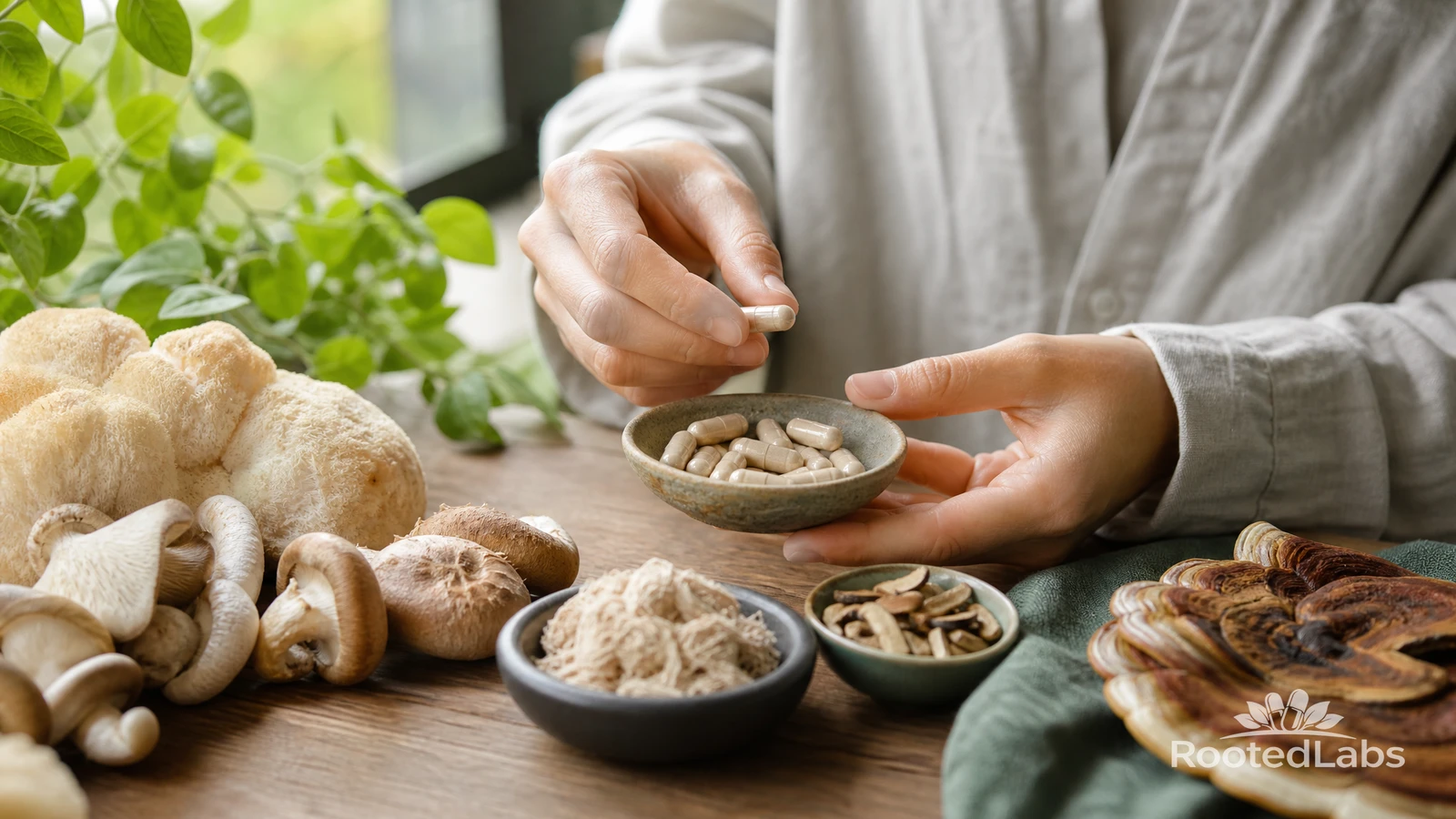
A mushroom supplement can look clean on the front of the bottle and still leave a major question unanswered: what is actually inside the capsule? For shoppers learning how to avoid grain fillers, the answer is rarely found in broad phrases like “mushroom complex” or “full spectrum.” It comes from the Supplement Facts panel, the ingredient list, and a brand’s willingness to state exactly what it uses.
Functional mushrooms have a long history of traditional use, but modern supplement quality depends on practical details. Is the product made from the fruiting body or mycelium? Is it a standardized extract or simply ground powder? Are the stated active compounds connected to the mushroom itself, or could they partly reflect the grain used to grow it? Clear labels make those questions easier to answer.
Why grain fillers show up in mushroom supplements
Mycelium is the thread-like root structure of a mushroom. In many commercial operations, it is grown on a grain-based substrate, commonly rice, oats, or sorghum. This approach can be efficient and cost-effective, particularly when a company dries and mills the entire cultivated material after growth.
The concern is not that grain is automatically unsafe, nor that mycelium has no value. The issue is proportion and transparency. When mycelium remains intertwined with its grain substrate, the finished powder can contain a meaningful amount of starch. If a label describes this simply as “mushroom,” consumers may reasonably assume they are receiving a concentrated mushroom ingredient when the capsule may also include residual grain material.
Fruiting-body extracts take a different route. The fruiting body is the visible mushroom structure, such as the Maitake cluster seen in nature. It can be extracted and standardized to help provide a more consistent concentration of selected compounds from batch to batch. For routine use, that consistency matters more than a long list of vague mushroom claims.
How to avoid grain fillers: start with the label
The front label is designed to communicate quickly. The back label is where formulation quality becomes clear. Turn the bottle around before comparing serving sizes, capsule counts, or price.
First, look for language that identifies the mushroom material. “100% fruiting body” is direct. So is a clear statement that the formula contains no mycelium or grain. By contrast, terms such as “mushroom biomass,” “myceliated grain,” or “mycelium on rice” indicate that grain may be part of the final ingredient. That may fit a brand’s approach, but it is not the same as a fruiting-body-only formula.
Next, check whether the label names the species. A quality Maitake product should identify Grifola frondosa, the botanical name for Maitake, rather than relying only on a general “proprietary mushroom blend.” Naming the species makes it easier to understand what you are taking and compare one formula with another.
Finally, read the other ingredients section. Capsule materials such as vegan HPMC are common and serve a functional purpose. The concern is unnecessary bulk: rice flour, maltodextrin, starches, or undisclosed processing aids added to stretch a formula or improve manufacturing economics. A short, understandable ingredient list is usually easier to evaluate.
Be careful with broad “polysaccharide” claims
Polysaccharides are often used as a selling point for mushroom supplements. They are a broad group of carbohydrates found in mushrooms, but also in grains and many other plants. A high polysaccharide number does not, by itself, prove that a product is fruiting-body-based or free from grain-derived material.
That does not make polysaccharide standardization meaningless. It simply needs context. Look for a brand that pairs its standardized percentage with clear sourcing information: the mushroom species, the plant part used, the extraction approach, and whether grain-based mycelium is excluded. A number is more useful when you know what it is measuring.
Beta-glucans can offer another point of comparison, but they also require careful reading. Test methods vary, and one isolated figure should not replace a transparent description of the full formula. The strongest labels show their work rather than asking you to make a decision from one large percentage on the front panel.
Know the difference between powder and extract
Mushroom powder and mushroom extract are not interchangeable terms. Powder is typically the dried, ground mushroom. It may be appropriate for culinary use or for people who specifically want a whole-food-style ingredient. But it is not necessarily concentrated, and its composition can vary.
An extract uses water, alcohol, or another controlled process to pull targeted compounds from the mushroom material. After extraction, the result can be standardized to a defined level of compounds such as polysaccharides. This gives a daily capsule a more predictable profile than a generic powder alone.
Neither format is automatically right for every person. A powder may be less processed and often costs less. A standardized extract is usually the better fit for someone who values consistency, clear potency, and a compact daily serving. The key is that the label should call the ingredient what it is. “Extract” should not be used loosely to make ordinary powder sound more concentrated.
Questions a transparent brand should answer
You should not have to email a company three times to learn whether its mushroom is grown on grain. A transparent supplement brand should make core details available on the bottle or product information.
Look for answers to these practical questions:
- Is the ingredient made from fruiting body, mycelium, or a combination of both?
- If mycelium is used, is the grain substrate removed before the final material is made?
- Is the ingredient a powder, an extract, or both?
- What compounds are standardized, and at what percentage?
- How many milligrams of the named mushroom are provided per serving?
- Where is the product manufactured, and are quality controls in place?
A company does not need to publish every internal production detail. It should, however, provide enough information for a customer to make an informed choice. When sourcing language is vague, treat that as missing information rather than assuming the best-case scenario.
Compare value by active mushroom content, not bottle size
A large bottle can create the impression of better value, but capsule count alone tells you very little. Compare the amount and type of mushroom material delivered in each daily serving. Then consider whether that amount is a standardized extract, a plain powder, or a grain-inclusive mycelium product.
For example, a lower-priced formula may contain a large number of capsules but provide only a modest amount of non-standardized material. Another formula may have fewer capsules yet offer a clearly listed fruiting-body extract with a defined standardization. The right choice depends on your budget and goals, but the comparison should be based on what you actually receive each day.
Botanical companions deserve the same attention. Turmeric and ginger can be useful additions when disclosed at meaningful amounts, while black pepper extract is often included to support absorption of certain botanical compounds. These ingredients should complement a mushroom formula, not distract from an unclear mushroom source. Magnesium citrate, if included, should also be plainly listed so customers can account for it within their overall supplement routine.
A practical standard for a daily mushroom routine
For a daily mushroom supplement, simplicity is a quality feature. Choose a formula that clearly identifies its species, uses a transparent form of mushroom material, states its serving size, and avoids unnecessary fillers. If fruiting body is your preference, look for that exact wording instead of assuming it from a mushroom image on the label.
RootedLabs follows this standard with 500 mg of standardized Maitake fruiting-body extract per serving, standardized to 50% polysaccharides, with no mycelium or grain fillers. The vegan capsule formula also includes organic turmeric, organic ginger, black pepper extract, and magnesium citrate, with manufacturing quality controls in the United States.
Consistency matters after you choose the product. Taking a supplement with breakfast, alongside coffee, or as part of an evening hydration habit is often more useful than building an elaborate protocol you will not maintain. Follow the label directions, especially if you are pregnant, nursing, managing a health condition, or taking medication. A clinician or pharmacist can help you assess individual ingredient considerations.
The clearest choice is usually the one that does not ask you to guess. When a label tells you the mushroom species, the plant part, the extract standard, and every supporting ingredient, you can spend less time decoding marketing and more time keeping a wellness routine that fits your real life.