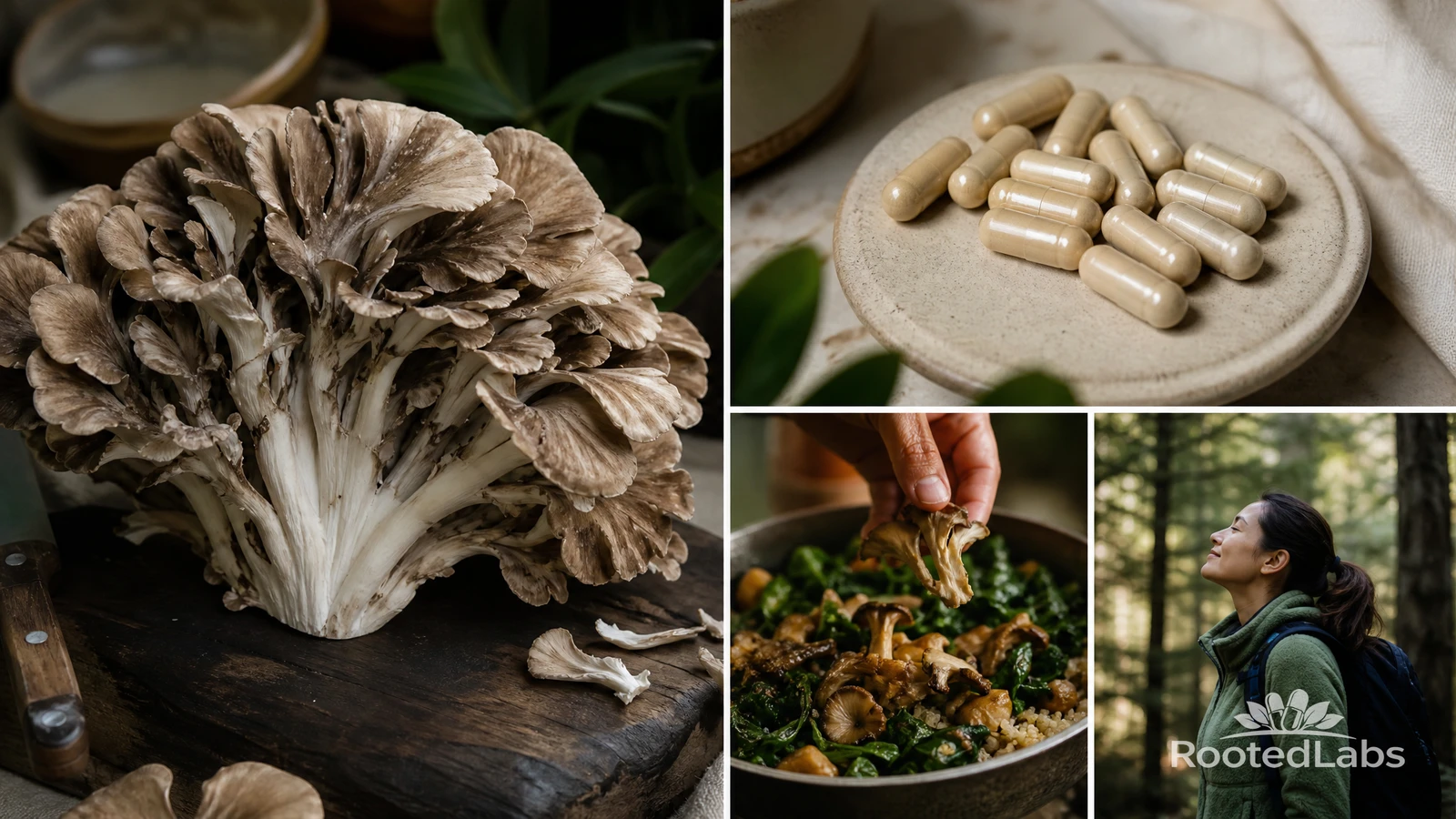
Maitake is often grouped with adaptogenic mushrooms, but the most accurate answer to “is maitake an adaptogen” is: not in the strictest sense. Maitake has a long history of traditional use and contains naturally occurring compounds associated with immune and antioxidant support. Still, its strongest identity is as a functional mushroom, not as a classic stress adaptogen.
That distinction matters when you are choosing a daily supplement. A good wellness routine should be built on clear expectations, consistent use, and formulas that say exactly what they contain. Maitake can be a practical part of that routine, especially for people who want broad, everyday support without chasing exaggerated claims.
Is Maitake an Adaptogen? The Straight Answer
An adaptogen is typically defined as a plant or mushroom that may help the body adapt to physical, chemical, or emotional stress while supporting normal balance in the body. Traditional adaptogens include herbs such as ashwagandha, rhodiola, and eleuthero. Among mushrooms, reishi is more commonly discussed in adaptogen-focused conversations.
Maitake does not have the same depth of human research specifically on stress adaptation as those better-known adaptogens. Calling it an adaptogen is not necessarily wrong in a broad functional-wellness context, but it can overstate what we know. Maitake is better described as a nutrient-dense functional mushroom with polysaccharides and other bioactive compounds that may support healthy immune function and the body's antioxidant defenses.
In other words, maitake may complement a steady wellness routine that supports resilience. It should not be positioned as a shortcut for stress, burnout, sleep problems, or a medical condition.
Why Maitake Is Often Included in Adaptogenic Routines
Adaptogenic routines are usually not about one ingredient doing everything. They tend to combine foundational habits - sleep, balanced meals, movement, hydration, and stress management - with botanicals or mushrooms chosen for broad support.
Maitake fits naturally into this kind of routine because it is valued for compounds called beta-glucans and other polysaccharides. These compounds are of particular interest for their interaction with normal immune activity. Rather than “boosting” the immune system in a simplistic way, mushroom polysaccharides are commonly studied for their potential to help support balanced immune responses.
Maitake also provides antioxidant-related support. Everyday life creates oxidative stress through normal metabolism, exercise, environmental exposure, and more. Antioxidant support is not a promise to erase those pressures. It is one part of maintaining a body that is well supported over time.
That is the practical connection: adaptogens are associated with resilience, and maitake is often used as a functional mushroom that supports foundational systems involved in resilience. The overlap is real, but the labels are not interchangeable.
What Research on Maitake Actually Suggests
Most research on maitake has focused on its polysaccharides, including beta-glucans and fractions isolated from the mushroom. Laboratory and animal studies have created meaningful interest in maitake's immune-modulating potential. Human research exists but remains more limited, often involving small sample sizes or specific extracts that may not match every supplement on the shelf.
For a consumer, the responsible takeaway is simple: maitake is promising, but it is not a cure, treatment, or replacement for medical care. Its value is best considered in the context of daily nutritional support.
Research quality also depends on the material studied. “Maitake” can refer to a whole mushroom powder, a mycelium-based product grown on grain, or a concentrated fruiting-body extract. Those are not automatically equivalent. A study using a defined extract cannot be assumed to apply to a capsule containing an unspecified mushroom powder and grain-based filler.
Fruiting Body and Extract Quality Make a Difference
The fruiting body is the visible mushroom structure most people recognize. It is the part traditionally used as food and is often preferred in premium mushroom supplements because it provides a direct, recognizable mushroom source.
Mycelium is the root-like network that helps a mushroom grow. Mycelium is not inherently poor quality, but products made with mycelium grown on grain can contain a meaningful amount of residual grain. If a label does not clearly state the mushroom source, extract ratio, or polysaccharide level, it can be difficult to know how much mushroom material you are actually getting.
For a daily maitake supplement, look beyond the front-label language. A transparent product should clearly identify its maitake source and amount per serving. Standardization adds another useful layer of consistency. For example, a 50% polysaccharide standardization provides a defined benchmark rather than relying on the variability of plain mushroom powder alone.
At RootedLabs, the focus is 100% fruiting-body maitake extract with 50% polysaccharides, not grain-based mycelium filler. Each serving provides 500 mg of standardized maitake extract in a vegan capsule, made in the USA under quality-controlled manufacturing standards. Strong inside. Steady outside.
Maitake Works Best as a Daily Practice
Functional mushrooms are not designed for a one-day wellness reset. Their role is better understood as consistent support alongside the habits that already shape health.
A simple routine is usually the one people can maintain. Taking maitake with breakfast, coffee, or your first glass of water can make the habit easier to remember. Taking capsules with food may also feel more comfortable for people with sensitive stomachs, especially when a formula includes complementary botanicals.
Some maitake formulas include turmeric, ginger, black pepper extract, or magnesium. These ingredients can make sense in a broader daily wellness formula, but each should be disclosed at a meaningful amount. Turmeric and ginger have long traditional histories, while black pepper extract is often used to support the absorption of certain turmeric compounds. Magnesium contributes to many normal body functions, including muscle and nerve function.
More ingredients are not always better. What matters is whether the formula is transparent, appropriately dosed, and easy to take consistently. A long proprietary blend can sound impressive while hiding the quantities that actually matter.
Who Should Be Careful With Maitake Supplements?
Maitake is commonly used as a food, and many adults tolerate mushroom supplements well. Still, “natural” does not mean right for every person.
If you are pregnant, nursing, managing a health condition, preparing for surgery, or taking prescription medication, check with a qualified healthcare professional before adding a maitake supplement. This is especially sensible for people using blood sugar medications, blood-thinning medication, or therapies that affect immune function. People with mushroom allergies should avoid maitake.
Pay attention to your own response as well. Starting with the label-directed serving and keeping the rest of your routine stable makes it easier to assess how a supplement fits you. A supplement should support your habits, not complicate them.
A More Useful Question Than the Label
Instead of asking only whether maitake qualifies as an adaptogen, ask what you want from it. If your goal is direct stress support, a classic adaptogen with relevant human research may be a better match. If you want a clean, standardized functional mushroom for everyday immune and antioxidant support, maitake is a thoughtful option.
The best choice is not the ingredient with the boldest promise. It is the one with a clear source, a stated standardization level, and a place in a routine you can keep. Maitake earns its place there not by pretending to solve everything, but by offering steady, well-defined support worth returning to each day.