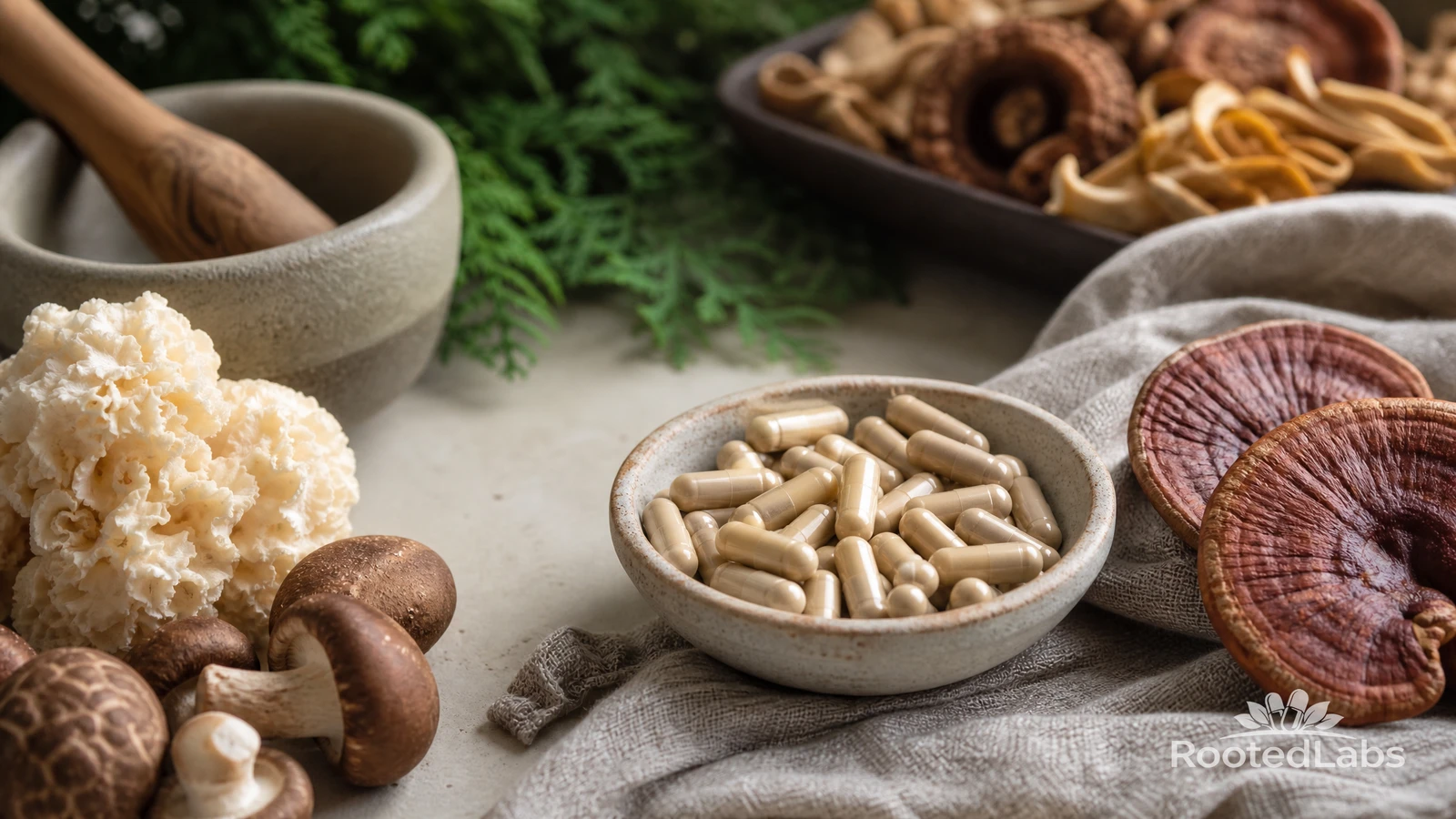
A mushroom capsule can look clean on a shelf and still leave major questions unanswered. Mushroom supplement testing is the process that turns broad claims such as “extract,” “pure,” or “high potency” into details you can evaluate: what species is present, how much active material the product contains, and whether it meets reasonable safety standards.
For a daily wellness routine, those details matter more than dramatic promises. A mushroom supplement should be easy to take, clearly labeled, and made with a level of testing that supports confidence from the first bottle to the next.
What Mushroom Supplement Testing Should Confirm
Testing is not one report or one number. A meaningful quality program checks several distinct parts of a finished supplement. Identity testing confirms that the ingredient is the mushroom species named on the label. Potency testing measures defined compounds associated with the extract. Purity testing looks for contaminants that do not belong in the product. Finished-product testing helps verify that the formula remains consistent after all ingredients are blended and encapsulated.
These checks answer different questions. A product can test positive for mushroom material yet provide little useful information about concentration. It can show a strong potency result while still lacking transparent contaminant testing. Looking at the full picture is more useful than relying on a single front-label claim.
For Maitake, shoppers should first be able to identify whether the formula uses fruiting body, mycelium, or a combination. Fruiting body is the visible, mature mushroom. Mycelium is the root-like network used to grow fungi, often on grain. Neither term alone establishes quality, but they are not interchangeable. A fruiting-body extract is a direct way to identify the mushroom material used, while grain-grown mycelium products can contain varying amounts of residual starch from the growing medium.
That distinction is especially relevant when a brand presents a potency percentage. If a formula is built around mushroom extract, the label should make clear what was extracted, what amount is provided per serving, and what compound or compound group was standardized.
Potency: Look Beyond a Large Milligram Number
A large milligram number may describe raw mushroom powder, an extract, or a blend with several ingredients. Without context, it does not tell you whether the material is concentrated or consistently measured.
Standardization helps solve that problem. It means the manufacturer has set a target level for a specified compound or compound group and tests to verify that the ingredient meets it. For example, a 500 mg Maitake extract standardized to 50% polysaccharides provides a more specific potency signal than 500 mg of unspecified mushroom powder.
Polysaccharides are commonly discussed in functional mushroom products, but the term deserves a careful reading. “Polysaccharides” is a broad category. Beta-glucans are a particular type of polysaccharide, and the two should not be treated as identical on a label. A company should state what its standardization measures rather than allowing shoppers to infer more than the test supports.
This is where a Supplement Facts panel earns its place. Look for the mushroom species, plant part or fungal material, extract amount per serving, and standardization statement. Vague phrases such as “mushroom complex” or “proprietary blend” make it harder to understand what you are actually taking each day.
Fruiting Body, Mycelium, and Hidden Grain
The most common source of confusion in mushroom supplements is not whether mushrooms are beneficial. It is whether the bottle contains the mushroom material consumers expect.
Mycelium can be cultivated on grain such as rice, oats, or sorghum. If the biomass is harvested without separating the mycelium from the grain, the resulting material may include significant starch. That does not automatically make a product unsafe, but it can make a high mushroom-content claim harder to assess. A label should disclose the material plainly instead of relying on imagery of mature mushrooms while leaving the actual ingredient source unclear.
A 100% fruiting-body formula offers a straightforward standard: the active mushroom ingredient comes from the mature mushroom, with no mycelium or grain filler presented as the core mushroom material. It is a clean comparison point for consumers who want a concentrated extract rather than a grain-based biomass powder.
Testing can support this distinction, but transparent sourcing and labeling matter too. A lab report cannot compensate for a label that avoids saying what was used.
Safety Testing Is Not Optional
Mushrooms are biologically active materials that can absorb compounds from their growing environment. That makes contaminant controls a practical part of quality, not a marketing extra.
A complete testing approach should consider heavy metals, microbial contaminants, pesticide residues, and residual solvents when extraction methods make them relevant. Heavy metal panels often include lead, arsenic, cadmium, and mercury. Microbial testing may screen for organisms such as Salmonella and E. coli, along with yeast and mold counts.
Results need context. “Tested for heavy metals” sounds reassuring, but a stronger standard is testing against defined specifications and confirming that each batch meets them. Likewise, a “third-party tested” statement is useful only when it refers to a credible independent laboratory and a relevant test panel. It does not automatically mean every ingredient, potency marker, and finished bottle has been verified in the same way.
Domestic manufacturing can add another layer of accountability when facilities follow current Good Manufacturing Practices. Still, “Made in the USA” describes where the product was manufactured, not necessarily where every botanical ingredient was grown. Both origin and manufacturing controls are worth asking about.
How to Read a Certificate of Analysis
A Certificate of Analysis, often called a COA, is a batch-specific document showing test results against product specifications. It can be valuable, but it should be read as evidence, not as a decorative badge.
First, check that the lot number on the document matches the lot number on the bottle or corresponds to the current production batch. An old report may show that a product was tested at some point, but it does not demonstrate current consistency.
Next, look for the test name, method, result, units, specification, and pass-or-fail status. A potency result without units or a stated specification is difficult to interpret. A contaminant panel that simply says “passed” may be less informative than one that identifies what was measured and the acceptable limit.
Finally, consider what was tested. An ingredient-level COA can confirm the quality of a raw extract. A finished-product COA adds confidence that blending and encapsulation did not create a problem. The ideal program may use both, depending on the ingredient and the manufacturer’s quality system.
Testing the Whole Formula, Not Just the Mushroom
Mushroom supplements are often paired with botanicals or supportive nutrients. Each addition should have a clear purpose, disclosed amount, and quality standard of its own.
Turmeric and ginger are familiar botanical partners in everyday wellness formulas. Black pepper extract is often included because piperine can support the absorption of certain compounds, though it may also interact with medications. Magnesium citrate is a commonly used mineral form, but the actual amount of elemental magnesium should be clear on the Supplement Facts panel.
A careful formula does not use supporting ingredients to disguise a weak mushroom dose. The mushroom extract should remain the foundation, with companion ingredients listed in transparent amounts rather than hidden inside a blend. If you take prescription medication, are pregnant or nursing, or have a medical condition, review botanical ingredients with a qualified healthcare professional before starting a new supplement.
A Practical Standard for Daily Use
For shoppers building a consistent routine, the most useful questions are simple. Is the mushroom species named? Does the label identify fruiting body or mycelium? Is the extract standardized to a clearly stated marker? Does the company describe safety testing and manufacturing controls? Are all ingredients and amounts visible?
RootedLabs applies that practical standard with 500 mg of standardized Maitake fruiting-body extract per serving, standardized to 50% polysaccharides, alongside organic turmeric, organic ginger, black pepper extract, and magnesium citrate in vegan HPMC capsules. The formula is built around 100% fruiting body and 0% mycelium or grain filler, with transparent Supplement Facts and quality-controlled US manufacturing.
Testing cannot turn a supplement into a cure, and no single capsule replaces sleep, nourishing food, movement, or medical care. What it can do is reduce uncertainty. Choose a formula whose identity, potency, and safety standards are clear enough to support the habit you plan to keep.