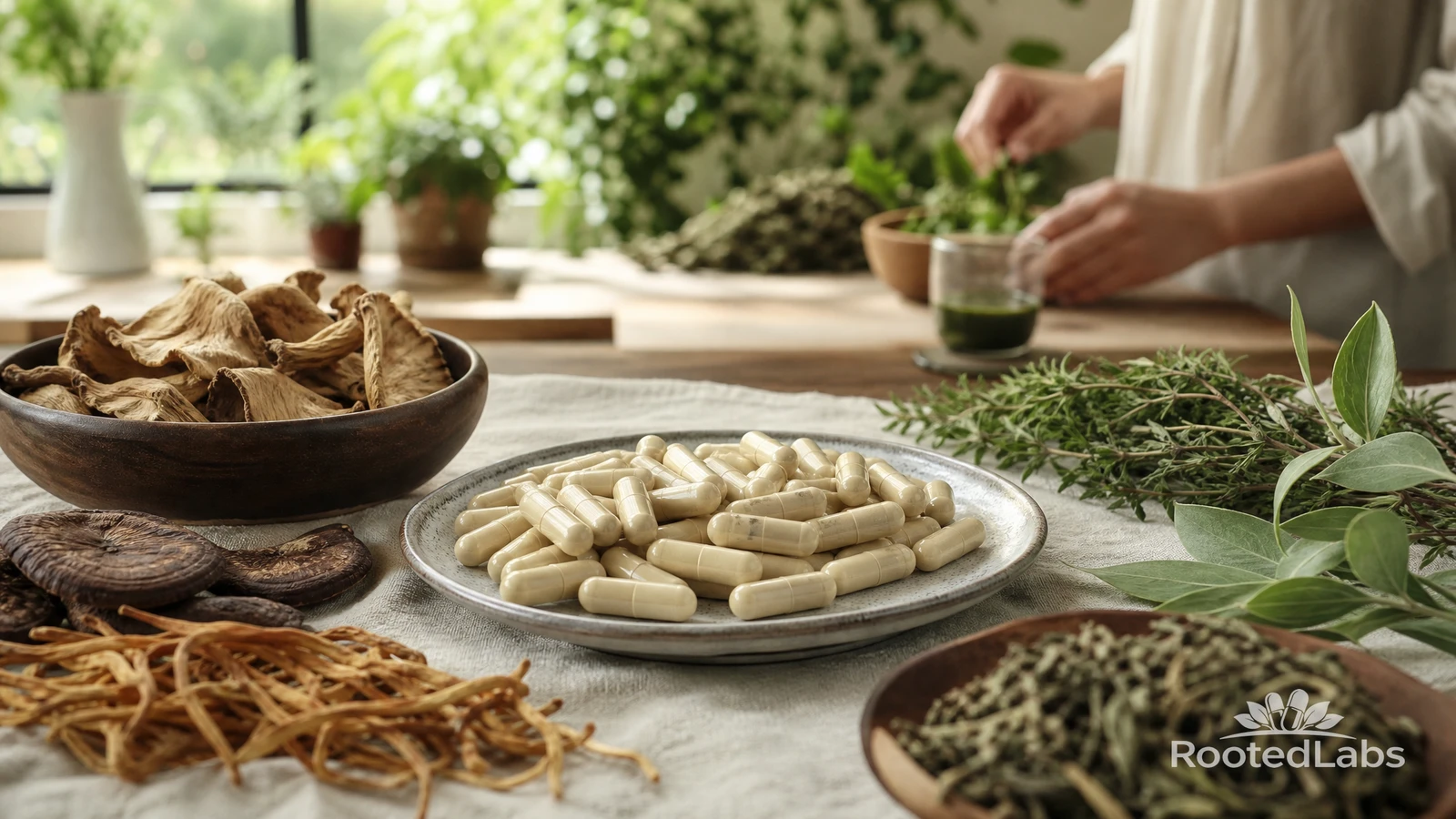
A capsule can be labeled vegan and still leave major questions unanswered. What is actually inside it? Is the stated active ingredient measured and standardized? Is the capsule itself vegan, or is only the main botanical plant-based? For people building a daily wellness routine, the best vegan supplement standards are not about a leaf icon on the front label. They are about proof, clarity, and a formula you can take consistently without guessing.
Best Vegan Supplement Standards Start With the Formula
A useful supplement label tells you more than the ingredient name. It identifies the form, amount, and purpose of each ingredient. That distinction matters with mushrooms, herbs, minerals, and nutrient blends, where two products can look similar on the shelf but deliver very different formulations.
Take maitake as an example. A label that simply says “maitake mushroom powder” does not tell you whether it is made from the fruiting body, mycelium, or a mixture grown on grain. It also does not tell you whether meaningful compounds have been measured. A standardized extract provides a clearer reference point because it identifies a target level of naturally occurring constituents, such as polysaccharides.
Standardization is not a promise of a specific health outcome. It is a quality control tool. It helps ensure that one batch is designed to match the next, which matters when a supplement is part of a long-term routine rather than a one-time experiment.
Look for the actual milligram amount per serving alongside the standardization statement. A high percentage without an identifiable dose can be hard to evaluate. On the other hand, a large milligram number without any information about extract quality may simply reflect raw powder. The strongest labels give you both pieces of information.
Fruiting Body Versus Mycelium
For mushroom supplements, this is one of the most practical standards to check. The fruiting body is the visible mushroom structure. Mycelium is the threadlike root-like network used to grow mushrooms. Neither term is automatically good or bad in every context, but a label should be direct about which material it uses.
Some mycelium products are grown on grain and sold with residual grain material. That can make it harder to know how much of the finished powder is mushroom-derived material versus starch from the growing medium. A 100% fruiting-body formula removes that particular question. It is a straightforward choice for shoppers who want mushroom extract without grain-based filler.
If a brand uses fruiting body, it should say so plainly. If it uses mycelium, it should identify the cultivation method and explain what the finished ingredient contains. Ambiguity is not a premium standard.
Verify That “Vegan” Applies to the Entire Product
The capsule shell is the obvious place to start. Traditional gelatin capsules are animal-derived, while HPMC capsules are plant-based and widely used for vegan supplements. A credible vegan product should identify its capsule material rather than asking shoppers to assume.
But the standard goes beyond the shell. Review the full Supplement Facts panel and the “other ingredients” section. Watch for unnecessary colorants, coatings, sweeteners, or proprietary blends that obscure what you are taking. Not every supporting ingredient is a problem. Some have a real functional role, such as black pepper extract included to complement turmeric in a botanical formula. The question is whether each ingredient is named, measured when relevant, and easy to understand.
Vegan status can also involve manufacturing controls. Companies that make both vegan and non-vegan products should have practices intended to manage cross-contact. For consumers with strict dietary preferences, asking how a product is made can be as reasonable as asking what is on the label.
Choose Transparent Doses Over Proprietary Blends
A proprietary blend may list several appealing ingredients while hiding the amount of each one. That makes comparison difficult. You cannot tell whether an ingredient is included at a meaningful level or added in a trace amount for label appeal.
Transparent dosing is more disciplined. It lets you see, for example, the amount of mushroom extract, the amount of turmeric and ginger, and the type and amount of magnesium used. This is especially useful if you already take other supplements and want to avoid unnecessary overlap.
More ingredients do not automatically make a formula better. A focused product often makes daily use easier because its purpose is clear. If the goal is mushroom-based wellness support, a formula centered on a clearly identified mushroom extract with complementary ingredients can be easier to evaluate than a crowded blend of dozens of botanicals.
There is a trade-off. Broad formulas may be convenient for people who want fewer bottles, while focused formulas give you more control over your routine. The better choice depends on what you already take and what you want the product to contribute.
Manufacturing Standards Should Be Specific
“Made in the USA” is meaningful only when it is paired with a real quality approach. Responsible US manufacturing typically involves documented procedures, ingredient identity checks, sanitation controls, and finished-product testing plans. A brand does not need to overwhelm customers with every internal record, but it should be prepared to explain its standards in plain language.
Look for manufacturers that follow current Good Manufacturing Practices, often shown as cGMP. This does not mean every bottle is identical by magic, nor does it replace careful sourcing. It does signal that production is expected to follow defined controls rather than informal processes.
Quality also begins before production. Botanical ingredients can vary by growing conditions, harvesting, and processing. Clear sourcing specifications and standardized extracts help reduce that variability. For a daily supplement, consistency is a practical benefit: you should not have to wonder whether the next bottle is fundamentally different from the last.
Third-party testing can add another layer of confidence, particularly when it addresses identity, purity, and contaminants relevant to the ingredient category. Still, do not treat a testing claim as a shortcut around the label. The best approach is to consider the full picture: transparent ingredients, disclosed doses, sensible manufacturing, and a company that answers direct questions.
Consider Bioavailability Without Chasing Buzzwords
A quality formulation considers how ingredients work together, but it should not turn that idea into exaggerated promises. For instance, black pepper extract is commonly included with turmeric because piperine is used to support the absorption of curcumin compounds. The useful standard is transparency: the label should identify the extract and its concentration rather than relying on vague language like “enhanced absorption.”
The same restraint applies to wellness claims. Supplements are not replacements for a varied diet, sleep, movement, or medical care. Be cautious with products that promise to cure illness, rapidly transform energy, or solve every wellness concern at once. A dependable supplement earns its place through quality and consistency, not dramatic language.
If you use medications, are pregnant or nursing, or manage a health condition, check with a qualified healthcare professional before adding a botanical or mineral supplement. Even clean, vegan ingredients can be inappropriate in certain situations or may require timing adjustments.
Use Packaging and Serving Size as Quality Signals
A good formula has limited value if the routine is difficult to maintain. Check the serving size, capsule count, and supply duration before buying. A 60-count bottle may support a 30-day routine at two capsules per day, while a 120-count bottle may offer 60 days. Those details affect cost, convenience, and how likely you are to stay consistent.
Capsules are often a practical choice for mushroom extracts because they avoid the earthy taste and measuring required by powders. They also make it easier to pair a supplement with an existing habit, such as breakfast, coffee, or a glass of water after a workout. The best routine is usually the one that is simple enough to repeat.
RootedLabs applies this standard with a 500 mg standardized maitake fruiting-body extract, 50% polysaccharides, vegan HPMC capsules, and a formula made without mycelium or grain fillers. Those are specific details a shopper can assess, not broad claims that require blind trust.
A Clear Standard Makes Better Daily Choices
When comparing vegan supplements, read past the front-label promise. Confirm the active form of the ingredient, the disclosed dose, the capsule material, the supporting ingredients, and the manufacturing practices behind the bottle. A product does not need an inflated ingredient list to meet a high standard. It needs to be clear about what it is, why each component is there, and how it fits into everyday use.
The right supplement should feel uncomplicated once you have checked the fundamentals: 100% fruiting body when that is your preference, 0% unnecessary filler, transparent potency, and a daily format you will actually use. That is a steadier foundation for wellness than any trend.